
A project manager in Johannesburg specifies brushed aluminum composite panels for a 200 m² feature wall — the order arrives, installation begins, and three panels in the middle of the run catch the light completely differently from the rest. The grain is running the wrong way on a third of the batch. Fixing it means pulling sheets, reordering, and delaying handover.
That single oversight — no grain direction specified on the purchase order — is the most common and most avoidable mistake in brushed ACP procurement. This guide covers what South African buyers, interior designers, and contractors need to lock down before placing a bulk order: grain direction, finish selection across silver, gold, champagne and matte variants, cutting layout, and sample approval.
What Buyers Need to Know About Brushed ACP Before Ordering
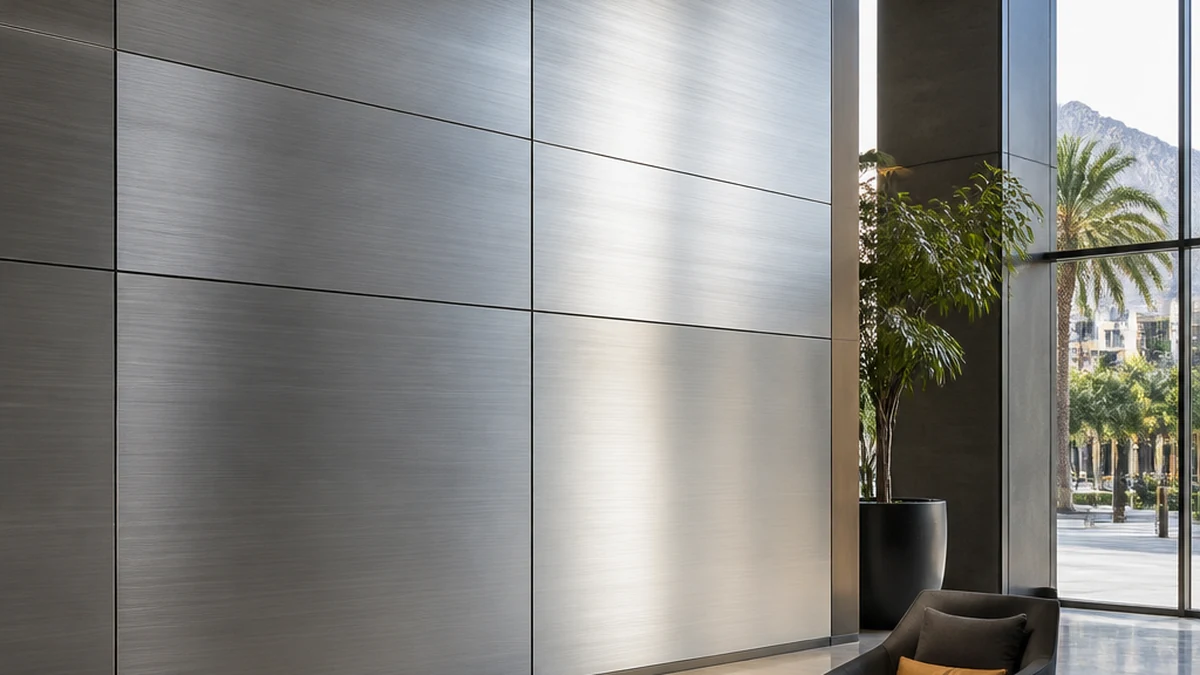
Brushed ACP finishes feature directional surface textures. Brushed aluminum composite panels are a three-layer product — two thin aluminium skins bonded to a core — where the outer skin carries a mechanically brushed texture rather than a flat painted finish.
Every buying decision downstream of that fact is shaped by it.
Aluminum skin thickness should be selected according to the panel’s intended application, fabrication requirements, and supplier specifications. Thinner aluminum skins are also available, but their suitability for a specific project should be confirmed through product data and sample evaluation.
Total panel thickness in commercial interior projects is most commonly 3 mm, with 4 mm used where greater rigidity is needed — for example, on panels spanning between fixing points wider than 600 mm. Both thicknesses are available in brushed finishes.
The core material defines the panel’s fire classification. For interior wall cladding in standard commercial applications — shopfitting, lobbies, office feature walls — confirm with your architect or fire consultant whether a PE (polyethylene) core is acceptable for your specific application and building type under South African requirements.
For any building facade or interior application in a building over 10 m in height, South African fire and building regulations impose requirements on core type; confirm the exact requirements with the local authority having jurisdiction and your fire consultant before specifying, as the applicable rules depend on your specific building classification.
(The designation “A2” you may see on imported spec sheets refers to a fire-rating classification system used in some international standards — confirm the correct South African fire-rating designation and its local equivalence with your architect or fire consultant before specifying.) Brushed ACP is available in both PE and fire-rated core types.
In South Africa’s construction and signage trade, “ACM panel” and “ACP” refer to the same product. Suppliers and fabricators use both terms interchangeably. When a specification document says ACP and a supplier quotes ACM in brushed finish, they are quoting the same panel.
| Specification | Typical Range | Application Note |
|---|---|---|
| Total panel thickness | 3 mm or 4 mm | 3 mm for most interior walls; 4 mm for wider span |
| Aluminium skin thickness | Varies by product specification | Confirm skin thickness against fabrication and project requirements |
| Core type (interior) | PE or FR | Confirm suitability with your fire consultant |
| Standard sheet size (SA) | 3200 × 1500 mm | Confirm dimensions against the cutting and installation layout |
| Grain direction | Factory-specified | Must be locked in writing at order stage |
Why Grain Direction Matters in Brushed ACP Orders
The brushed texture on an aluminium composite panel is produced during the coil-coating process, when the aluminium skin passes through a mechanical brushing stage before bonding. This stage runs in one direction along the coil — which means every sheet cut from that coil has a grain running parallel to its long axis, unless the sheet is cross-cut. Once that sheet leaves the factory, the grain direction is fixed.
Horizontal vs Vertical Grain Direction
Horizontal grain means the brushed lines run across the width of the installed panel. Vertical grain runs top to bottom. Neither is inherently superior — the choice is a design decision, and both are achievable at the factory level. The factory default is to produce sheets with grain parallel to the panel’s long dimension.
For standard portrait-format cladding panels on a wall, where the long axis is vertical, grain parallel to that axis produces a vertical brushed appearance. Aluminum composite panels are widely used in interior design applications, including feature walls, lobbies, and retail spaces. The required grain orientation should be determined by the intended visual effect and confirmed before ordering.
If your installation requires horizontal grain on a portrait-format panel, or any grain direction on a landscape-format panel where the long axis runs horizontally, you must specify the required orientation explicitly on the purchase order; the factory will otherwise produce to the long-axis default, which may or may not be what your design requires.
Ceiling panels, wide-format horizontal band applications, and any panel installed in landscape orientation all need an explicit grain call-out on the purchase order.
How Grain Direction Affects Adjacent Panels
Place two brushed aluminum composite panels side by side under raking light. If grain directions differ even slightly — one running at 0°, the other at 1° off — the panels will reflect light at detectably different angles. The wall reads as patchy rather than continuous. This is not a defect in either panel individually; it is a specification failure.

The effect is most pronounced on brushed silver and brushed gold finishes, where the reflective aluminium surface amplifies any directional discrepancy. Matte brushed finishes are more forgiving — but that forgiveness is limited. Matte is not immune to grain mismatch; it merely reduces the contrast between misaligned panels. Buyers who treat matte as a safe default and skip the grain call-out still encounter visible inconsistency on large wall areas.
The grain discipline is the same regardless of sheen level.
The only protection is a written grain direction callout on every line item of your purchase order — “grain horizontal” or “grain vertical” — confirmed on the factory sample before production begins.
Choosing Brushed ACP Finishes for Multi-Panel Interior Projects
Brushed Silver, Gold, and Other Available Finishes
Brushed ACP is produced in a range of colour and texture combinations. The most specified finishes in South African commercial interior projects are:
- Brushed silver — the baseline; natural aluminium tone with a linear satin sheen. Works across corporate lobbies, retail fit-outs, and kitchen feature walls.
- Brushed gold — a warm metallic tone achieved through a coloured coating over the brushed substrate. Premium positioning; common in hospitality interiors.
- Brushed champagne / rose gold — softer variants of the gold tone; increasingly requested for high-end residential and boutique retail.
- Brushed dark finishes (anthracite, black) — darker base colours with visible brush texture. Popular in contemporary office and entertainment venue fit-outs.
Standard brushed finishes cover most interior briefs, but standard brushed silver or champagne does not always match an existing interior palette — particularly when a project is extending or refreshing a space where original panels are still in situ. This is where custom colour matching on brushed ACP becomes genuinely important, and also genuinely harder than on solid PVDF panels.
The brushed substrate affects perceived colour: the directional texture scatters light differently at different viewing angles, which means a colour that reads as a close match on a flat swatch can read as noticeably different when applied over a brushed surface.
ALUWEDO offers a range of colour options with brushed finishes — confirm the current available options directly with the supplier, as the range may vary — and for tight palette-matching requirements, requesting a brushed sample in the specific candidate colour (not a flat colour chip) is the only reliable test.
Matching Finish Appearance Across Large Wall Areas
Colour matching across a large interior wall is where brushed ACP projects most frequently disappoint. Two distinct failure modes drive this.
The first is colour drift between production batches — panels produced weeks apart from different coil stocks may show a subtle hue shift under the same lighting. This is a batch consistency issue, not a manufacturing defect; it reflects normal variation in raw material between coil lots.
The second is gloss level variation — the degree of sheen on a brushed finish can shift if brushing pressure or coating application weight changes between production runs. A slightly thicker colour coat mutes the brushed texture; a thinner one makes it more pronounced. Both can be within technical specification and still look different side by side on a wall.
The practical fix for interior projects covering more than roughly 50 m² is to order total quantity from a single production batch. Specify the full quantity upfront, even if installation is phased. Panels from one continuous run share the same coil stock and process settings.
The 50 m² threshold is a commonly used rule of thumb in the trade; the underlying principle — that batch consistency risk increases with project area — applies at any scale, and you should agree a specific approach with your supplier based on your project’s requirements.
🔍 Worth checking: Ask for the batch number and coil origin on the production record before approving shipment. A single batch number across all panels is a stronger consistency guarantee than a verbal assurance.
For projects where splitting a single production run is unavoidable, request two physical samples — one from the start of production and one from the end — and compare them under the actual lighting conditions of the installation site, not under a fluorescent tube in a warehouse.
Panel Size and Cutting Layout for Brushed ACP Orders
Standard Sheet Sizes vs Custom-Cut Panels
Common aluminium composite panel sheet sizes available in South Africa include formats such as 3200 × 1500 mm and 2440 × 1220 mm, among others; confirm current stock sizes with your supplier, as availability can vary.
The suitability of a 3200 × 1500 mm sheet depends on the supporting frame layout, fixing method, and cutting plan. Buyers should confirm the available sheet dimensions and installation requirements with their supplier before ordering.
Creasing during transit is a significant concern on brushed finishes, as the texture is difficult or impossible to restore without visible damage; confirm packaging and transport requirements with your supplier before ordering.
At 4 mm thickness, a brushed ACP sheet’s weight depends on its exact dimensions and aluminium skin thickness — confirm the sheet weight with your supplier before undertaking any load calculations. Many local distributors stock the legacy 2440 × 1220 mm format inherited from the hardware trade.
When panels are installed with the 3200 mm dimension running horizontally across a 10 m wall, approximately four panels are needed to cover the run, producing three vertical joints; with the 2440 mm dimension running horizontally, approximately five panels are needed, producing four joints. Fewer joints means a cleaner surface and less sealant cost.
For projects with non-standard dimensions — curved feature walls, reception desk cladding, or ceiling coffers — factory-cut panels allow the fabricator to receive ready-to-install sheets rather than trimming standard boards on site. Offcut waste from ripping oversized stock is a real cost addition; the exact proportion depends on layout efficiency, but on irregular formats it is common for waste to add meaningfully to the effective cost per square metre.
How Cutting Orientation Affects Grain Consistency
When a standard sheet is cut into smaller panels, the cut orientation determines whether the grain runs the same direction on every resulting piece.
If a sheet with vertical grain is cut into four equal portrait-format panels, all four retain vertical grain. Cutting a sheet does not change its original grain direction. The apparent horizontal or vertical grain depends on how each cut panel is oriented during installation. The cutting plan should therefore mark the grain direction on every finished piece and specify its intended installation orientation.
Grain inconsistencies can occur when cut panels or offcuts are installed in different orientations. Although cutting does not change the original brushed grain, rotating a finished piece during installation can make its grain appear perpendicular to adjacent panels. This problem often originates from a specification gap: the cutting plan does not clearly indicate the required grain direction for each finished panel.
🚫 Avoid: Approving a cutting plan for brushed aluminum composite panels that does not include a grain direction indicator on every panel. A simple arrow on the layout drawing costs nothing and prevents the most common installation complaint.
How to Check Brushed ACP Samples Before Bulk Production
Checking Grain Direction and Surface Appearance
A physical sample is non-negotiable before approving bulk production of brushed aluminum composite panels. Computer screens are not reliable colour references for metallic finishes — the angle of your monitor relative to ambient light changes the perceived hue and sheen of a brushed surface completely.
When you receive a sample, hold it under the lighting conditions of the intended installation space. Check:
- Grain direction — confirm which axis the brushed lines run. Mark it with an arrow on the sample itself.
- Surface uniformity — no roller marks, no areas of inconsistent brush depth, no contamination under the protective film.
- Film adhesion — the protective film should be fully adhered with no lifting at edges. Lifting film during transit exposes the brushed surface to scratching.
- Edge quality — cut edges should be clean with no burring. Burred edges indicate a worn blade; the same blade sharpness applies to your production sheets.
Hold the sample at a low raking angle — approximately 15° to 20° from horizontal — to make surface irregularities visible that would be invisible at a straight-on viewing angle. This replicates how light hits a wall panel in a real installation.
Confirming Finish Consistency Across Panels
One sample tells you what a single panel looks like. It does not tell you whether the finish is consistent across the full production run. For any interior project where more than 20 panels share an uninterrupted wall surface, request two samples: one from the beginning of the production run and one from the end.
Compare them side by side under identical lighting. Any visible hue shift between samples is a concern worth raising with your supplier; agree a clear, written tolerance standard with your supplier before production begins — not after delivery — so that both parties have a shared basis for acceptance or rejection.
For brushed gold and brushed champagne finishes specifically, the colour layer sits on top of the brushed aluminium substrate, and the coating thickness affects both the perceived colour depth and the sheen level. Physical sample approval locks the coating weight for your production run.
Common Bulk Ordering Mistakes with Brushed ACP
Ordering Without a Specified Grain Direction
This is the single most expensive mistake in brushed ACP procurement, and it is entirely preventable. A purchase order that reads “brushed silver ACP, 4 mm, 3200 × 1500 mm, 80 sheets” contains no grain instruction. The factory will produce to its default — grain parallel to the long axis of the sheet — which may or may not match your installation requirement.
If your design calls for horizontal grain across a wide wall, and the factory ships vertical-grain panels, every sheet must be rotated 90° during installation. On portrait-format panels, that rotation changes the panel’s aspect ratio relative to the fixing layout. On wide-format panels, it may make the panel too narrow to span the required height.
The rework cost is not just the panels — it is the fabricator’s time, the delay to the project programme, and in some cases a complete reorder.
Write the grain direction on every line item. No exceptions.
Mixing Panels from Different Production Batches
A South African contractor ordering 60 brushed aluminum composite panels for a phased fit-out places an initial order of 40 panels, then reorders 20 panels six weeks later. The second batch arrives from a different aluminium coil stock. Under the same lighting, the two groups read as slightly different tones — not dramatically different, but enough to be visible at the seam between the two installation phases.
This is a batch consistency problem, not a quality defect. Both batches may be within standard production tolerances. The issue is that “within tolerance” on a brushed metallic finish can still be visually detectable in a continuous installation.
The counterintuitive implication: ordering the full project quantity in a single purchase order — even when storage is inconvenient or cash flow favours phased spending — is often more cost-effective than splitting the order. The saving on storage or working capital rarely offsets the rework cost and programme delay that a batch mismatch triggers mid-project.
Specify that all panels must come from a single production batch, and ask for the batch reference number on the delivery documentation. If a second order is unavoidable, request a retained sample from the first batch so the supplier can colour-match the new production against it before shipping.
Final Checks Before Ordering Brushed ACP Panels
Before releasing a brushed aluminum composite panel order for production, confirm each of the following. Any one of these missed at specification stage surfaces as a problem during installation, when resolution costs substantially more.
- Grain direction confirmed in writing — horizontal or vertical, on every line item, confirmed against the approved physical sample.
- Total quantity ordered as a single batch — batch number declared on packing list and delivery documentation.
- Cutting plan reviewed for grain direction — orientation diagrams show grain on every resulting panel, not just the parent sheet.
- Core type confirmed against fire classification — confirm the required core type with your fire consultant and the local authority having jurisdiction before specifying, in accordance with applicable South African building and fire regulations.
- Physical samples approved under installation lighting — not on a screen, not under warehouse fluorescent lighting.
- Two samples requested for large runs — start and end of production, compared side by side.
- Protective film integrity checked — fully adhered, no tears, directional arrows where applicable.
ALUWEDO is an established manufacturer of aluminium composite panels supplying the South African market direct from the factory — confirm current lead times, product range and manufacturing details directly with the supplier. The right time to engage — with grain direction, finish selection, and batch strategy locked — is before the cutting plan is finalised, not after the container is loaded.
FAQ
What is the thickness of aluminum composite panels?
Brushed aluminum composite panels are available in different overall thicknesses, with 3 mm and 4 mm commonly considered for interior cladding projects. Aluminum skin thickness varies by product specification and is not limited to 0.3–0.5 mm. Buyers should confirm the panel thickness, skin thickness, and fabrication requirements with their supplier before ordering.
Is ACM cheaper than aluminum?
Aluminum composite material (ACM) can be more cost-effective than solid aluminum sheet for some interior cladding applications, depending on panel thickness, finish, fabrication requirements, and project quantity. Buyers should compare material costs, cutting waste, installation requirements, and finish consistency rather than relying on the initial sheet price alone
How do you ensure consistent grain direction in bulk ACP orders?
Specify the required horizontal or vertical grain direction on the purchase order and mark it on every panel in the cutting layout. Approve a physical brushed ACP sample before production and confirm that the supplier uses consistent orientation markings. For large orders, also check finish consistency across production batches and retain an approved sample for comparison during inspection.
Sources
[1] A Stylish Upgrade to Interior Design with Aluminum Composite Panels — fiduciaryglass.com
[2] Custom Colors for Aluminum Composite Panels — jp.aluwell.tw


