

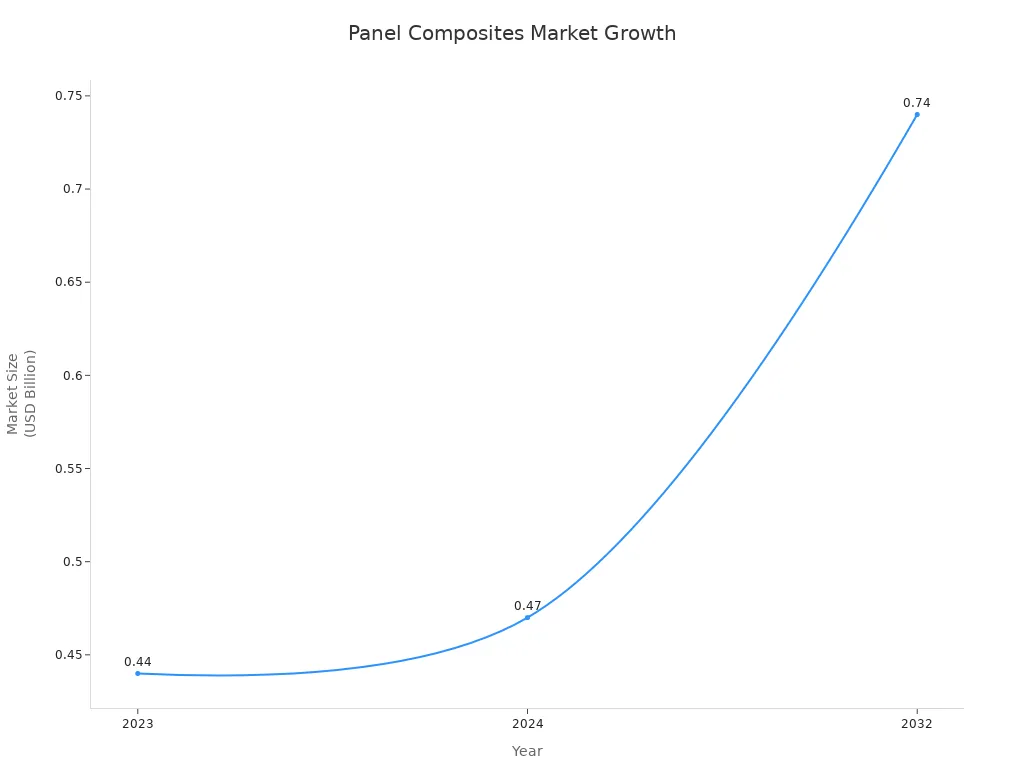
You see panel composite materials everywhere, from building walls to car interiors. The construction industry uses over half of all composite panels, with automotive and signage following closely. As urban areas grow, the market for these panels expands fast. The Asia-Pacific region leads in manufacturing and demand. You choose the right panel composite by considering durability, energy efficiency, and appearance.

What Is a Panel Composite?
Simple Definition of Panel Composite
You can think of a panel composite as a building block made from two or more different materials. These materials work together to create a strong, lightweight structure. The Composite Panel Association sets standards for these products. According to these standards, a panel composite is a structural element made of multiple layers or materials that act as one unit. Each layer keeps its own properties, but together, they form a panel with special features. For example, composite panels often use a core material sandwiched between two outer layers. This design gives you better strength, stability, and durability than using just one material alone.
Composite panels stand out because they combine the best qualities of each material. You get high strength-to-weight ratios, resistance to corrosion, and more design options. Composite cladding panels, which you see on many modern buildings, use this technology to protect and decorate walls. These panels also meet strict performance and safety standards, making them a smart choice for many projects.
How Composite Panels Work
When you use composite panels, you take advantage of how different materials interact. Each part of the panel has a job. The outer layers, called facings, give the panel its strength and protect it from damage. The core, often made from foam or honeycomb, keeps the panel light but stiff. This setup is called a sandwich construction. It lets composite cladding panels handle heavy loads without bending or breaking.
You will notice that composite materials in these panels stay separate but work together. This teamwork gives composite panels their unique properties. For example, you can mold composite cladding panels into many shapes. You can also add reinforcements or inserts to handle extra stress. Unlike traditional materials, composite panels offer more flexibility and better performance. The materials used in composite panels let you create walls, roofs, and even furniture that last longer and look better.
Tip: When you choose composite panels, you get a product that combines strength, lightness, and design freedom. This makes them perfect for many uses, from buildings to vehicles.
Main Types of Composite Panels

Aluminum Composite Panels
You will find aluminum composite panels in many modern buildings and vehicles. These composite cladding panels use two thin aluminum sheets bonded to a core material. The core can be polyethylene or a fire-resistant mineral-filled material. This design gives you a panel that is lightweight, strong, and easy to install. You can use these panels for curtain walls, cladding, and even signage.
Aluminum composite panels offer several advantages. They resist corrosion and provide good thermal insulation. You can choose panels with fire-resistant cores for extra safety. Many manufacturers now use nano-level coatings to improve water protection and extend the life of the panels. You can recycle these panels, which helps protect the environment.
Note: Aluminum composite panels are the most common composite cladding panels in construction. You will see them used for their flatness, lightweight nature, and flexibility in design.
The mechanical properties of these composite panels include high bending strength, flexural modulus, and peel strength. You can rely on them to handle wind pressure and other forces. The structure of these composite cladding panels ensures strong reinforcement and structural integrity. You can shape and color the panels to match your design needs.
Fiber-Reinforced Composite Panels
Fiber-reinforced composite panels use a polymer matrix with fibers like glass, carbon, or aramid for reinforcement. You will see these composite cladding panels in cars, airplanes, and buildings. These panels stand out because they combine high strength with low weight. You can use them where you need durability without adding much weight.
You will notice that fiber-reinforced composite panels resist corrosion better than steel. This makes them a good choice for harsh environments, such as coastal areas or chemical plants. You can mold these composite cladding panels into complex shapes, which allows for creative designs. The strength-to-weight ratio of these composite materials improves fuel efficiency in vehicles and makes handling easier.
- Typical uses for fiber-reinforced composite panels:
- Automotive body panels
- Aircraft interiors
- Building facades
- Utility pipes
You can also find hybrid composite cladding panels that combine fiber-reinforced materials with metals. These panels give you the reinforcement of fibers and the strength of steel. You get improved insulation, durability, and a longer lifespan for your projects.
Natural Fiber Composite Panels
Natural fiber composite panels use plant-based fibers, such as flax or hemp, mixed with a polymer matrix. You will find these composite cladding panels in cars, construction, and even some furniture. These panels offer you a more sustainable option compared to synthetic composites.
| Aspect | Natural Fiber Composites (NFCs) | Synthetic Fiber Composites |
|---|---|---|
| Environmental Impact | Lower carbon footprint, biodegradable, recyclable | Higher carbon footprint, less biodegradable |
| Mechanical Strength | Lower absolute strength, but good specific strength due to low density | Higher absolute strength, more consistent |
| Durability | Sensitive to moisture and UV, variable properties | Better moisture and UV resistance |
| Applications | Automotive, construction, aerospace | Where high durability is needed |
You will see that natural fiber composite cladding panels have lower absolute strength than glass or carbon fiber panels. However, their specific strength can be similar because they are lighter. You can benefit from their renewability, biodegradability, and low cost. These composite panels absorb carbon during plant growth, which helps reduce environmental impact.
Tip: You can improve the mechanical properties of natural fiber composite cladding panels by combining them with synthetic fibers. This hybrid approach gives you better reinforcement and durability.
You should remember that natural fiber composite panels can absorb moisture and lose strength if exposed to water or sunlight for long periods. You need to design these composite cladding panels carefully to balance strength, durability, and environmental benefits.
Sandwich Panels with Foam or Honeycomb Cores
You see sandwich panels with foam or honeycomb cores in many engineering and architectural projects. These composite panels use two thin face sheets bonded to a thick, lightweight core. The core supports against buckling and resists out-of-plane shear. You get panels that are light but very stiff. This design helps you achieve structural integrity without adding much weight.
Honeycomb cores give you several advantages. You can choose from materials like aramid paper, fiberglass, aluminum, steel, or titanium. Each material offers a different strength-to-weight ratio and energy absorption. Honeycomb cores increase panel stiffness and often remove the need for extra stiffeners. You can control mechanical and crashworthy characteristics by changing cell size, wall thickness, and core height. Small cells work well for flat components, while larger cells suit curved parts.
Foam cores also provide strength and shape, especially in lighter aircraft. You can select foam cores based on compressive strength, fire resistance, and adhesive compatibility. Foam cores are heavier and less strong than honeycomb cores, but they still offer good reinforcement for many uses.
Tip: You can improve impact resistance and energy absorption by adjusting honeycomb foil thickness or reducing cell size. Thicker facesheets also help resist penetration and deformation.
You will notice that sandwich composite cladding panels absorb energy through progressive folding of cell walls during crushing. This feature makes them ideal for aerospace and transportation. You can use these types of composites to build lighter, stiffer, and safer structures. Sandwich panels with foam or honeycomb cores show how composite materials use structural mechanics to deliver high strength and durability.
- Key features of sandwich composite cladding panels:
- Enhanced bending stiffness at minimal weight
- High energy absorption and crash resistance
- Tailored reinforcement for different applications
- Lightweight design for easier installation
Advanced Composite Panels (Carbon Fiber, Glass Fiber)
You find advanced composite panels in high-performance industries. Carbon fiber panels and glass fiber panels are the most common types of composites in this group. You use these composite cladding panels when you need superior strength, low weight, and excellent durability.
Carbon fiber panels give you the highest strength-to-weight ratio. You can rely on them for aerospace, automotive, and sports equipment. Glass fiber panels offer good strength and better impact resistance. You see them in chemical plants and places where toughness matters.
| Property | Carbon Fiber Composite Panels | Glass Fiber Composite Panels |
|---|---|---|
| Weight | Approximately 70% lighter than fiberglass | Heavier compared to carbon fiber |
| Strength | Over 20% stronger than the best fiberglass | Strong but less than carbon fiber |
| Rigidity | Extremely rigid, maintains shape under stress | More flexible, less rigid |
| Durability | Superior wear resistance, better for high-stress and high-temperature environments | Better impact resistance and chemical durability |
| Cost | More expensive but offers better performance and longevity | More affordable, suitable for cost-sensitive applications |
You can see that carbon fiber panels are lightweight and very strong. You use them where you need high strength and flexibility. Glass fiber panels are heavier but offer better impact resistance. You choose glass fiber panels for chemical resistance and durability.
Note: You can combine carbon fiber with other materials like Kevlar for even better wear resistance and reinforcement.
You select advanced composite cladding panels based on your project needs. If you want the best performance and longevity, you pick carbon fiber panels. If you need cost savings and toughness, you choose glass fiber panels. Both types of composites provide excellent reinforcement and structural integrity for demanding applications.
Wood-Plastic Composite Panels
You see wood-plastic composite panels in outdoor decking, fencing, and furniture. These composite cladding panels mix wood fibers with thermoplastics. You get panels that look like wood but last longer and need less maintenance.
You can make wood-plastic composite panels more environmentally friendly by using wood waste and recycled or bio-based plastics. Wood fiber usually comes from sawdust or wood waste, which reduces deforestation. Thermoplastics like PE, PVC, PP, and PS mostly come from fossil fuels, but you can lower the carbon footprint by using recycled or bio-based plastics. Local sourcing also helps reduce emissions from transportation.
- Environmental benefits of wood-plastic composite panels:
- Use of recycled wood fibers and plastics increases resource efficiency
- Carbon storage from wood content helps lower global warming potential
- Durability extends product lifespan and reduces environmental impact
- Low maintenance means you use fewer resources for upkeep
- Lightweight design reduces energy use during transport
- Panels are often recyclable at the end of their service life
You notice that wood-plastic composite cladding panels offer good strength and durability. You do not need to sand or repaint them often. You can recycle these panels, which supports a circular economy. Fully bio-based and biodegradable wood-plastic composite panels give you the most sustainable option.
Tip: You can improve the environmental impact of wood-plastic composite panels by choosing products made from recycled materials and managing recycling properly.
You select wood-plastic composite cladding panels when you want a balance of strength, appearance, and sustainability. These composite panels show how you can use types of composites to create products that last longer and help the environment.
Applications of Composite Panels by Industry

Construction and Architecture Applications
You see composite cladding panels used in many architectural applications. These panels help you build energy-efficient building designs because they are lightweight and strong. You can install them quickly, which saves time and labor. Composite cladding panels resist moisture, rot, and corrosion, so buildings last longer and need less maintenance. You often find these panels on exterior walls, roofs, and facades. They also work well for interior partitions and ceilings.
| Industry | Primary Purpose(s) |
|---|---|
| Architecture | Durable, lightweight building materials |
| Industrial | Strength, durability, resistance to chemicals |
Composite cladding panels are up to 60% lighter than traditional materials. This makes them easy to handle and reduces the load on building structures. You can choose from many colors and finishes to match your design. These panels help you meet green building standards because they use recycled materials and last a long time.
Tip: Use composite cladding panels for both new construction and renovation projects to improve durability and energy efficiency.
Transportation Applications (Automotive, Aerospace, Rail)
You find composite cladding panels in many transportation applications. In the automobile industry, you use these panels for body parts, doors, and trunk lids. Composite cladding panels help reduce vehicle weight, which improves fuel efficiency and performance. You also see them in buses, trains, and airplanes. In aerospace, composite cladding panels make up parts of the fuselage and wings. These panels give you a better strength-to-weight ratio than metal.
- Composite cladding panels in transportation:
- Reduce weight for better fuel economy
- Resist corrosion for longer life
- Allow complex shapes for better aerodynamics
- Improve safety with high impact resistance
In the automobile sector, composite cladding panels help you build lighter cars. This means you get better acceleration and longer battery life in electric vehicles. In aerospace, these panels help planes use less fuel and carry more cargo. You also see composite cladding panels in rail cars, where they lower weight and increase speed.
Interior Design and Furniture Applications
You use composite cladding panels in many interior design and furniture applications. These panels let you create modern, stylish spaces with less effort. You can choose panels with 3D textures, metallic finishes, or natural wood looks. Composite cladding panels are popular for wall panels, cabinetry, and furniture surfaces.
- Design trends for composite cladding panels:
- Textured and 3D wall panels for depth and style
- Eco-friendly panels made from recycled materials
- Metallic finishes for a luxury look
- Natural wood aesthetics for warmth and comfort
Composite cladding panels help you design sustainable interiors. They use recycled wood fibers and store carbon, which supports green building goals. You can also use these panels to create colorful kitchens, geometric patterns, and curved furniture. Composite cladding panels are strong, easy to clean, and last a long time. You see them in homes, offices, and public spaces.
Note: Composite cladding panels give you flexibility in design and help you meet sustainability targets in furniture and interior projects.
Exterior Cladding and Facade Applications
You see composite cladding panels used in many exterior applications. These panels protect buildings from harsh weather and give them a modern look. You can use composite cladding panels for facades, balconies, and even roof edges. They resist rotting, cracking, and insect damage. You do not need to worry about fading from sun exposure or damage from freeze-thaw cycles. Composite cladding panels require little maintenance, so you save time and money.
Many builders choose composite cladding panels because they last a long time. High-quality panels can last 25 years or more. You get strong weather resistance and fire-retardant properties. Composite cladding panels also handle UV rays, moisture, and temperature changes. If you install them with a rainscreen system, you help manage moisture and prevent water from getting inside. This keeps your building safe and dry.
You will notice that composite cladding panels offer better performance than traditional wood. They resist insects and moisture, and they do not rot. You can pick from many colors and finishes to match your design. Even though the initial cost is higher, you save money over time because these panels last longer and need less care. Composite cladding panels are a smart choice for exterior applications where you want durability and style.
Tip: Always follow the manufacturer’s installation guide. Proper installation helps composite cladding panels reach their full lifespan in exterior applications.
Marine and Signage Applications
You find composite cladding panels in many marine and signage applications. In the marine industry, you use these panels for boat windows, enclosures, and protective covers. Marine-grade composite cladding panels, like polycarbonate sheets, offer extreme impact resistance and optical clarity. They are lightweight, so you can install them easily. These panels resist UV rays, fungi, and corrosion. You can trust them to protect equipment and passengers from salt spray and humidity.
For signage, composite cladding panels help you create signs that last. You can choose any size, color, or finish. These panels are lightweight and easy to mount. They resist weather, moisture, and fire, which makes them perfect for outdoor signs in tough climates. You can print custom patterns or graphics on the panels to meet your needs.
- Key features for marine and signage applications:
- Lightweight for easy handling
- High impact and weather resistance
- Customizable for different designs
- Good thermal insulation for energy savings
You see that composite cladding panels meet strict performance needs in both marine and signage applications. They help you build safe, durable, and attractive solutions for many uses.
How to Select the Right Panel Composite
Performance Requirements and Mechanical Properties
When you start choosing the right composite panel, you need to focus on performance. You want a panel that meets your project’s demands. Each composite offers different mechanical properties. You should look at how much force the panel can handle before it bends, breaks, or tears. You also need to check how well the panel resists water, heat, and chemicals.
Here is a table that shows the most important performance criteria for composite panels:
| Performance Criterion | Description and Importance |
|---|---|
| Compressive Strength | Measures the maximum force a material can withstand before deforming or breaking, critical for load-bearing applications. |
| Flexural Strength | Indicates the stress a material can sustain before yielding in bending, important for rigidity. |
| Flexural Modulus | Ratio of stress to strain in bending, relates to resistance to deflection in structural panels. |
| Shear Strength | Maximum stress before material tears or breaks due to sliding layers, important for layered composites. |
| Shear Modulus | Resistance to shearing deformation, predicts how shear energy transmits through the material. |
| Peel Strength | Adhesive strength between bonded layers, crucial for sandwich panel integrity. |
| Moisture Resistance | Ability to resist water absorption and degradation, essential for outdoor or humid environments. |
| Thermal Conductivity | Ability to conduct or insulate heat, important for thermal management in applications. |
| Chemical and Corrosion Resistance | Resistance to industrial chemicals, solvents, and corrosion, ensuring durability in harsh environments. |
| Flammability | Fire resistance and self-extinguishing properties, critical for safety in aerospace and other regulated industries. |
| Weight | Lightweight materials are preferred in aerospace and automotive sectors to meet performance and regulatory demands. |
| Cost-effectiveness | Balancing material properties with budget constraints to avoid over-engineering and unnecessary expense. |
You need to think about strength, stiffness, and toughness. Strength tells you how much stress the composite can take before it fails. Stiffness shows how much the panel resists bending. Toughness means the panel can absorb energy without cracking. You also need to consider temperature and humidity. High temperatures can change the mechanical properties of some composites. Moisture can cause some panels to weaken or degrade.
You can measure mechanical properties using standard tests. Tensile strength uses ASTM D3039 or ISO 527. Compressive strength uses ASTM D3410 or ISO 14126. Flexural strength uses ASTM D7264 or ISO 14125. Impact resistance uses ASTM D256 or ISO 179. These tests help you compare the performance of different composite panels.
You can predict the tensile modulus of a composite using this formula:
Ec = Ef * Vf + Em * Vm
Where:
- Ec = composite modulus
- Ef = fiber modulus
- Vf = fiber volume fraction
- Em = matrix modulus
- Vm = matrix volume fraction
Flexural modulus can be calculated from bending test parameters:
Ef = (L^3 / 4bd^3) * (ΔP / Δδ)
Where L is span length, b is specimen width, d is specimen thickness, ΔP is change in load, and Δδ is change in deflection.
You will find that carbon fiber epoxy composites have the highest tensile strength. Glass fiber composites show the best flexural strength. Kevlar-epoxy composites provide the highest impact strength and hardness. These differences help you match the composite to your project’s needs.
Tip: Always match the mechanical properties of the composite to the demands of your application. This ensures the best performance and safety.
Budget and Cost Considerations
You need to balance performance with cost when you select a composite panel. Some panels cost less at first but need more maintenance later. Others cost more up front but last longer and save money over time. You should look at both the initial price and the long-term value.
Here is a table that compares the costs and maintenance needs of common composite panels:
| Panel Type | Initial Cost | Durability & Maintenance | Installation Complexity |
|---|---|---|---|
| PE Aluminum Composite | Lowest | Lower durability; higher long-term maintenance | Simple, low cost |
| HPL Panels | Mid-range | Decent durability; requires regular upkeep | Moderate |
| Fiber Cement Panels | Higher | Porous surface; higher maintenance costs | Heavy; needs specialized equipment |
| PVDF Aluminum Composite | Highest initial cost | Superior durability; minimal maintenance | Lightweight; easier installation |
PE aluminum composite panels give you the lowest initial cost. You may spend more on repairs and upkeep because they do not last as long. HPL panels offer a balance between price and durability. Fiber cement panels cost more to install and maintain because they are heavy and porous. PVDF aluminum composite panels cost the most up front but offer the best durability and lowest maintenance. You save money over time with these panels.
You should also think about installation. Lightweight composite panels are easier and cheaper to install. Heavy panels need special equipment and more labor. This adds to the total cost of your project.
Note: When you plan your budget, include both the purchase price and the cost of installation and maintenance. This helps you avoid surprises and choose the most cost-effective composite for your needs.
Aesthetic Preferences and Design Flexibility
You want your project to look good and stand out. Composite panels give you many design options. You can choose from a wide range of colors, textures, and finishes. Some panels look like wood or stone. Others have metallic or glossy surfaces. You can even get panels with anti-graffiti or reflective coatings for special uses.
Here are some popular finishes and design choices for composite panels:
- Standard colors: primary, metallic, matte, and custom colors
- Textures: smooth, rugged, metallic, wood, and stone
- Finishes: glossy, matte, translucent, and high-gloss
- Specialized coatings: anti-graffiti, reflective, UV-resistant
- Design flexibility: panels can be cut, shaped, and curved for unique projects
You can use composite panels for both interior and exterior applications. You get durability and style at the same time. You can create modern, sleek designs or natural, warm looks. Composite panels let you match your project’s theme and branding.
You also benefit from the functional advantages of composite panels. Many panels resist UV rays and weather. Some improve energy efficiency by reflecting sunlight or insulating heat. You can use these panels in homes, offices, schools, and public buildings.
Tip: When you choose a composite panel, think about both appearance and function. The right finish and design can improve your project’s value and appeal.
You see that choosing the right composite panel means looking at performance, cost, and design. You get the advantages of strength, durability, and style. You make your project safer, more efficient, and more attractive.
Fire Resistance and Safety Standards
You need to pay close attention to fire resistance and safety when you select composite panels. Fire can spread quickly in buildings, so you want panels that slow it down and protect people. Fire resistance ratings tell you how long a panel can keep its strength during a fire. These ratings use time intervals like 30, 60, 90, or 120 minutes. You see these numbers after panels go through tests by groups such as ASTM and ISO. The tests check flame spread, heat resistance, smoke production, and how well the panel holds up under fire.
You should match the fire resistance rating to the risk level in your building. For example, a 30-minute rating works for low-risk areas. A 60-minute rating fits most commercial spaces. Hospitals and factories often need 90 minutes or more. You also need to look at fire rating classifications. These classes show how well a panel resists fire and smoke. Here is a table that explains the main classes:
| Fire Resistance Class | Description |
|---|---|
| A1 (EN 13501-1) | Non-combustible, highest fire resistance |
| B-s2, d0 | High fire resistance with low smoke and no flaming droplets (typical for high-density composite cladding) |
| C-s3, d1 | Moderate fire resistance with moderate smoke and flaming droplets (standard composite cladding) |
| D-s3, d2 | Lower fire resistance with higher smoke and flaming droplets (low-density composite cladding) |
Most commercial buildings require at least a B-s2, d0 rating. This means the panel has high fire resistance, produces little smoke, and does not drip flaming material. You must also follow fire safety standards set by codes like the International Building Code (IBC) and National Fire Protection Association (NFPA). These codes require panels to pass tests such as ASTM E119. When a panel passes, it gets a certification that proves it meets safety and fire performance rules.
You need to install panels the right way to keep their fire resistance and insulation properties. Use fire-rated adhesives and sealants. Follow the manufacturer’s instructions. In tall buildings, fire barrier systems help stop fire and smoke from moving between floors. You protect lives and property when you choose panels with the right fire rating classifications and follow fire safety standards.
Tip: Always check the fire rating classifications and certifications before you buy composite panels. This step helps you meet safety and fire performance requirements for your project.
Sustainability and Environmental Impact
You want to choose composite panels that support sustainability and protect the environment. Sustainable panels use less energy and create less waste during production. They also last longer and can be recycled or reused. You can check a panel’s environmental impact by looking at its Environmental Product Declaration (EPD). An EPD gives you a full life cycle assessment, from raw materials to disposal. It shows energy use, emissions, waste, and what happens at the end of the panel’s life.
Groups like the American Composites Manufacturers Association (ACMA) and the Consortium for Research on Renewable Industrial Materials (CORRIM) help set rules for these reports. They make sure EPDs follow global standards such as ISO 21930:2017. You can trust EPDs that are verified by ASTM International. These reports let you compare different panels and pick the one that best meets your environmental sustainability goals.
Sustainable composite panels, like particleboard and MDF, often use recycled wood or plant fibers. They store carbon and reduce the need for new raw materials. Some panels use bio-based plastics or recycled plastics, which lowers their carbon footprint. You also see panels designed for easy recycling at the end of their use. When you choose panels with strong sustainability credentials, you help reduce pollution and save resources.
Note: Look for panels with EPDs and certifications. These documents prove the panel meets strict sustainability standards and supports your environmental sustainability goals.
Installation and Maintenance Needs
You want composite panels that save you time and effort during installation and maintenance. Modern composite panels install quickly. Skilled workers can put up foundation panels in less than two hours. You do not need much training to do the job right. After installation, you spend very little time on upkeep. Most panels only need cleaning every five years. You do not have to seal or paint them every year like you do with wood.
Here is a table that compares traditional wood and modern composite panels:
| Feature | Traditional Wood | Modern Composite |
|---|---|---|
| Installation Time | 3-5 days | 1-2 days |
| Maintenance Cycle | Annual sealing | Cleaning every 5 years |
| Warranty Period | 2-5 years | 8-12 years |
Modern composite panels often come with warranties for up to 20 years against fading or peeling. Labor warranties usually last five years and cover things like flashings and sealants. You need to follow the manufacturer’s instructions for installation. This step keeps your warranty valid and helps the panels last longer. Good installation also lets the panels handle changes in temperature without damage.
You will notice that modern composite panels have higher recycled content and lower yearly upkeep costs than wood. Contractors say these panels help finish projects about 40% faster. You get a durable, low-maintenance product that saves you money and time.
Tip: Choose composite panels with clear installation and maintenance guidelines. This choice helps you get the best results and longest life from your panels.
Common Misconceptions and Troubleshooting for Composite Panels
Myths About Panel Composite Performance
You might hear some common myths about composite panels. Many people think composite fencing or decking is not durable. In reality, composite materials are engineered to resist rot, mold, bacteria, insect damage, and harsh weather much better than wood. Some believe composite fencing costs more than it is worth. While the initial price is higher, you save money over time because composite panels need little maintenance, come with long warranties, and last up to five times longer than wood.
Early composite decking sometimes faded, warped, or looked unattractive. Modern composite panels have improved a lot. Today, you get excellent resistance to mold, mildew, UV damage, and stains. These advances give you a product with strong performance and a long lifespan. You can trust composite panels to deliver reliable results in many environments, including those with high fire risk.
Remember: Composite panels now offer high performance, durability, and cost savings over their lifetime.
Troubleshooting Common Issues with Composite Panels
You may face some issues with composite panels, but you can fix most of them with the right steps. The most common problems include fiber breakage, delaminations, matrix cracks, voids, chemical attack, and even damage from lightning strikes. Each issue can affect the performance and fire safety of your panels.
To repair damage, you often need to remove the affected area. You can use hand tools, power tools, water jet cutting, or laser ablation. Always shape the removal area to reduce stress points. If moisture is present, dry the panel using heat lamps, hot air, or vacuum methods. Clean the surface with solvents or detergents, and use abrasion or special treatments to improve adhesion.
When you apply repairs, you might use bonded patches or bolted repairs. Sometimes, you combine both for extra strength. After repairs, inspect the panel with non-destructive testing like ultrasonic or X-ray scans. Keep monitoring the panel to ensure long-term performance and fire resistance.
Tip: Regular inspection and proper repair methods help you maintain the performance and fire safety of your composite panels.
You have many composite panel options, such as aluminum, carbon fiber, and sandwich panels. Each type offers unique benefits for construction, transportation, interiors, and more. When you select a panel, consider fire safety, durability, insulation, cost, and sustainability.
- Always check for compliance with building codes and fire standards.
- Look for panels with proven weather resistance and low maintenance.
- Match your choice to your project’s climate and design needs.
For best results, define your project goals and consult technical experts or resources like Avient and GlobalSpec. This helps you make confident, informed decisions.
FAQ
What is the main advantage of using composite panels?
You get strong and lightweight panels. Composite panels last longer than many traditional materials. They resist weather, moisture, and insects. You can also choose from many colors and finishes to match your project.
Can you recycle composite panels?
Yes, you can recycle many composite panels. Some panels use recycled materials from the start. Always check with your supplier for recycling options in your area.
How do you clean composite panels?
You can clean composite panels with mild soap and water. Use a soft cloth or sponge. Avoid harsh chemicals or abrasive tools. Regular cleaning keeps panels looking new.
Are composite panels safe for indoor use?
Yes, composite panels are safe for indoor use. Many panels meet strict safety and fire standards. Always check for certifications before you buy.
Do composite panels need a lot of maintenance?
No, composite panels need very little maintenance. You do not need to paint or seal them every year. Just clean them as needed to keep them in good shape.


